There was an interesting discussion between Kitchen Scribble and Jessie X about whether a CSA should be using sources up and down the coast to supplement their items delivered that aren’t in season locally. Two of the local CSAs offer winter and/or spring shares that include items from outside the Mason Dixon area.
I can see both sides of the discussion. I was originally one who defined CSA as supporting a local farmer.
I found that it isn’t that simple for the farmer. If the source of fruit and vegetables is confined to a very small area with no coordination, there are inherent risks like our hurricanes, tropical storms and flooding, that may impact one farmer. Those risks are shared by the farmers and the CSA members. I now can see that cooperatives of many farmers banding together provide individual farmers less risk, and that risk is also lessened for the CSA members.
Having a network of small farmers also provides variety. Many friends give up on CSAs after a year or two because they are tired of getting corn for eight weeks, or greens for weeks on end. Diversity of the products is what keeps people like me interested in their CSA box every week. Napa cabbage, tatsoi and blue squash, for example, in the fall last year.
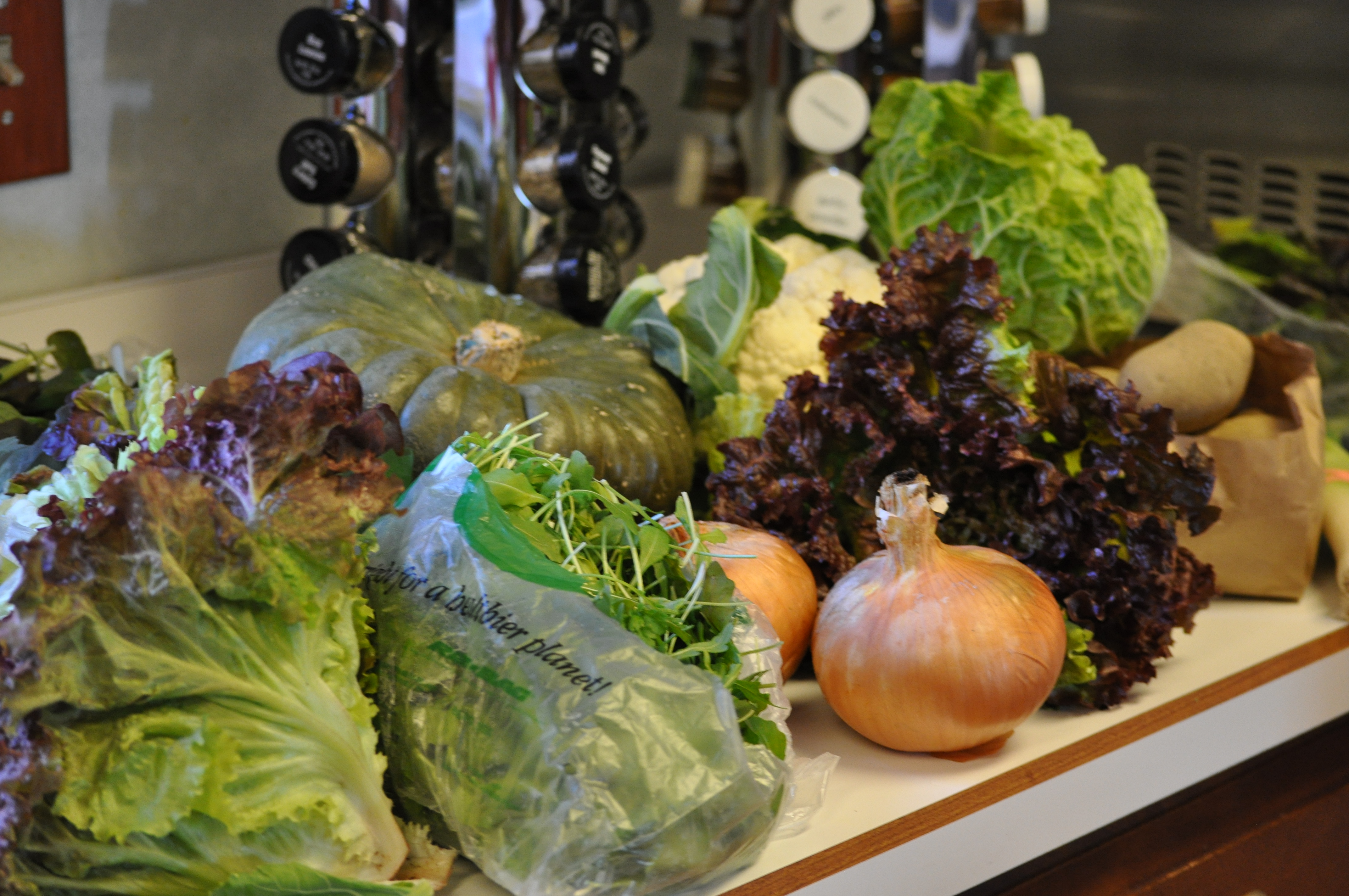
This winter we joined the Zahradka Farm CSA, knowing in advance that they partner with farms in MD and PA for meat, and that they got shipments of citrus from Florida. We went on line every week to order. With a half share, we chose six items, from a list of 12-15 items. You could double or triple an item as long as you kept the total to six. We had an option to add eggs. We had an option to add meat. I knew when I made my choices the first week that the cranberry apple chutney included non local fruit, and that the oranges were from Florida. I could have chosen only items from Zahradka if I wanted all the dollars to go to them.

We could buy honey and other items on line to be sent with our order. One week in the “store” they were offering frozen half turkeys left over from the Christmas orders for those who wanted them. We already had one in the freezer from our meat share.

Our summer CSA choice is Sandy Spring. We originally chose them because they delivered to the Conservancy where I volunteer. Having a convenient site for pick up was important to me. The Monday delivery was better for us than a weekend one, when we might have been out of the area for the day, or away for a weekend. This year, they are doing pick up in Columbia, and on Thursdays. A better day for us, but not as convenient a site (it is actually close, but the traffic in Columbia adds time to the journey).
For me, the community part of CSA is having our local community supporting farmers. I am not that concerned about the location of the farms as I am about the viability of organic small farms. I like the fact that Lancaster Farm Fresh Coop, the supplying farmers to Sandy Spring, consists of a group of 60-70 family farmers, most of whom are growing on five or less acres. These family farmers, working together in their community, provide a smorgasbord of heirloom veggies to more than 5000 families within a 150 mile radius of Lancaster County.
These farmers open their farms to the CSA members for potluck picnics. There are two already scheduled for May and June this year. We will be visiting the farms and sharing a meal with some of the members from as far away as Harlem, NY. Last year they chartered a bus to attend one of the picnics. It is fun to see what people make and bring to the picnics.
After last winter, I don’t know whether I will do another winter CSA. I did feel in my CSA box that there were too many root veggies coming in greater quantities than we eat. When many of the choices were sweet potatoes, potatoes, red onions, yellow onions week after week, I knew I had to find a different way. I also ended up drowning in carrots. Even though I like them and use them often, the sheer size and amount in a weekly order was daunting. Like this week. The carrots and potatoes alone were more than enough for the two of us.

I can get meat and eggs, root veggies and pantry items out at Breezy Willow on Saturdays. I go into Breezy Willow knowing they partner with other farmers and offer some citrus from Florida, and veggies from east coast farmers. I am OK with that. they offer a great selection of local meat, they have eggs, and yes, they offer citrus from Florida at the farm store, since they bring it in for the winter/spring CSA.

For those that don’t belong to CSA’s, what are your reasons? For those who do, how do you define CSA? Have you found one that fits your needs and your style of cooking?
hocofood@@@


 AnnieRie Unplugged
I am enjoying your posts so much. I am a vegetarian who lives in Columbia and have been a member of Breezy Willow’s CSA for several years. I love this CSA…the food, people, recipes, variety, value added shares, and the feeling of being part of the family. It means something to be able to support local farms.
Also Love, Love, Love the Conservancy.
Thank you for the compliment. I love supporting our Howard County farms, and I also really enjoy the huge variety that Sandy Spring provides me. So, I support both.
I live near Glenwood and I am close to Breezy Willow and TLV. I buy from both of them year round. In the summer, I almost never go to grocery stores. The local farms and the CSA get most of my food budget.
Thoughtful, interesting post, Annie. I can see your perspective and get it. And I’m still a bit of a purist around the term CSA. It’s kind of like my “purist” attitude toward the use of the term “farmer’s market.” When I start seeing citrus or bananas for sale at an area “farmer’s market,” I start to question whether the other produce for sale is legit or just repackaged to look like a farmer’s market.
But I guess if someone is working with an actual farm that is growing much of its produce and sourcing the rest from other good-practice, small farmers, that is another business model that may not be purist but meets customer demand.
Hi Jessie, I was pretty much a purist a year ago, but changed my position after talking to the farmers. A business model that keeps people as customers is important, as long as it doesn’t get really out of hand.
The balance is what I look at. If the “farm stand” is just a front for a reseller, I have a problem with it. I know the local farmers don’t like resellers coming into markets and undercutting their prices. The Howard County markets don’t allow resellers, and that is a good thng.
We don’t grow citrus here. It is always from another state, so I don’t mind that addition in my CSA box.
I think for me full disclosure is key. If I make an informed decision, I am OK with it. If someone is deceptive about sources, that will bother me.
I agree with your point about full disclosure. I think for me, intention is key – I really admire farmers who are trying really, really hard to farm in a conscientious way, and I understand that it can be incredibly hard to make a living that way. The co-op idea is great. It seems like the ideal is something like the farm described in the book The Dirty Life. But that’s a pretty tough ideal to attain, and I’m happy to support any farm that is trying. And I definitely want transparency about anything they bring in to supplement!